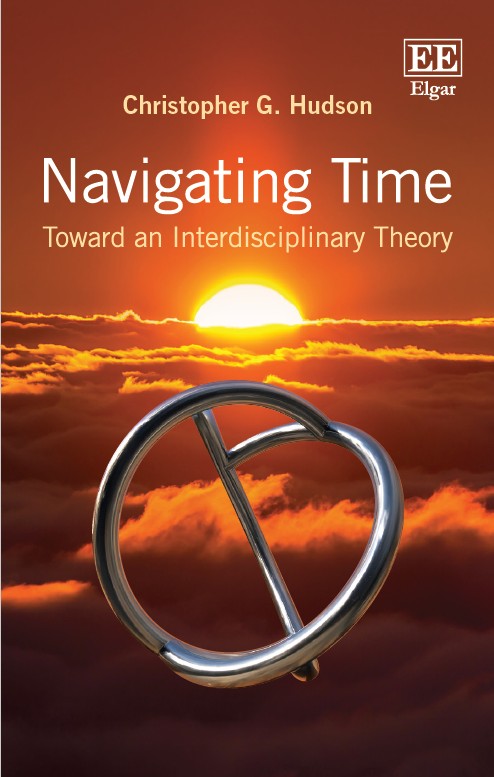
The decision to write a book on the subject of time has not been taken lightly, and in fact, it is one that I have contemplated for several years. Much has already been written on the subject, much of which is speculative and unrelated to practical life. Furthermore, I was not trained as a philosopher or a physicist, but received my Ph.D. in social policy. Most of my academic career has involved, in addition to teaching Master of Social Work (MSW) students, conducting and publishing interdisciplinary theoretical and empirical studies on international mental health policy, complex systems, psychiatric epidemiology, and social problems such as homelessness. I have rarely found the opportunity or confidence to tackle such a multifaceted issue as time.
Yet, for most of my life, I have been intrigued by issues such as the nature of time and consciousness and their spiritual dimensions. During my childhood, I lived with my family in several nations as my father was a hydrogeologist with the United Nations. These included Saudi Arabia, Bolivia, Ecuador, Taiwan, Jordan, and Switzerland, in addition to our hometown of Yellow Springs, Ohio, in the US. Thus, over these years, I was exposed to numerous cultural and spiritual traditions, as well as their associated sites, notably Assisi and St. Mark's in Italy; Baalbek in Lebanon; Jerusalem in Israel; Ellora and Meherabad in India; the Himalayas in Nepal and Tibet; and Machu Picchu in Peru. Each of these has evoked in me a sense of timelessness, of the eternal threads that run through and connect our lives. Numerous other early influences, such as my mother's poetry (Hudson, J. B. 2024) and T. S. Eliot's Four Quartets (1962), also have moved me to regularly explore the nature of time and the timeless. It was during my college years at the University of Chicago that I delved even more deeply into such issues, especially in philosophical psychology and the history of religions. Perhaps the most important influence during these and subsequent years has been my exposure to the life and teachings of Avatar Meher Baba (1894–1969) (see Chapter 8).
During my early work as a community organizer and as a psychotherapist in the 1970s, followed by my 36-year career in academia, I largely tabled these interests, but never my fascination with and ongoing study of them. I then retired from university teaching in 2019, and found that retirement only served to intensify my fascination with the nature of time and the seemingly disparate philosophies, theories, and attitudes associated with it, as well as their significance for the everyday life of individuals and societies. Thus, I decided to write this book, one that aims to provide a balanced exploration of both seminal issues involved with the fundamental nature of time and their application to our lives, revolving around the theme of competence in navigating time, both on an individual and societal level.
The last three years spent preparing and writing this book have been one of the most exciting journeys of intellectual discovery in my life, as it has deepened my appreciation for numerous disciplines that have been relatively new to me. Besides extensive reading and discussions with colleagues, one of the most important parts of this work took place during off hours when I undertook treks in Africa, Switzerland, and Nepal, as well as long walks in Lincoln Park, close to my home here in Chicago. During these times, I spent many hours grappling with the ideas I had immersed myself in during my preparatory research for the chapters I was writing at the time. Also, invaluable has been my ability to persuade at least a dozen or so professional colleagues to read and provide feedback on various sections and chapters from my writing, which has served to build my confidence that this book may make some contribution to the literature on time.
Several of the most important themes and ideas of this book did not fully crystallize until I was already through the first two-thirds of the writing. These include the idea that time emerges from a trifecta of consciousness, change, and the timeless; that time and temporality are an evolving process involving the interactions within this trifecta, one symbolized by the metaphor of a team of weavers working on a loom; and the notion that competence in navigating time is, in part, a function of the ability to implement the ideal of kairos introduced by several Greek philosophers. But perhaps one of the most central ideas of the book, and one that may be difficult for many, is that time competence requires the ability to access the eternal, at least some reflections of it in the changeless and the timeless. Because several of these themes did not emerge until later on, I was forced to revisit my introductory chapters and provide some appropriate foreshadowing of these ideas that are not fully developed until the last half of the book.
On the one hand, given the preliminary feedback I've received, I believe that most readers will find the book fairly understandable and even of interest. On the other hand, I would also like to forewarn my readers, especially those without sufficient background, that there are a few sections that will be dense and difficult to follow, mostly in Chapter 9 when I present as a whole the theory that I am advancing. If this is your experience, feel free to skip this section, as the essential ideas are summarized with greater clarity in the chapter conclusions and in the epilogue of the book (Chapter 12). One final point is that this is not a scientific or even a philosophical work per se, but one that is interdisciplinary, one that seeks to contribute some novel insights to the scholarship on time through an exploration of multiple perspectives from the several disciplines examined, and to identify possible avenues for reconciling them. As such, it is important that the reader does not expect the theory advanced in this book to be a completed one, but only a work in progress. And my hope is that you will find at least a few of its ideas to be ones that you can develop in your own work and implement in your life.
Christopher G. Hudson, Ph.D.